
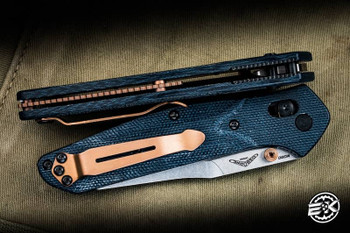
A Battle of Benchmades: Bugout vs. 940 Osborne
Posted by EKnives on Nov 18th 2025
If you've spent any time exploring premium folding knives, you've probably crossed paths with two icons of the Benchmade lineup: the Benchmade Bugout and the 940 Osborne.
These two popular EDC options are modern legends. Both are sleek, reliable, and built to perform, but they serve slightly different missions. One aims for ultralight freedom. The other offers timeless durability. Let's break down what makes each one special so you can decide which deserves that coveted spot in your pocket.
Minimalist Efficiency vs. Classic Muscle
Benchmade created the Bugout for one purpose: to strip away every unnecessary ounce. Its Grivory or CF-Elite handles, paired with a streamlined profile, make it one of the lightest full-size folders on the market. It practically disappears in your pocket, which is perfect for hikers, travelers, or anyone who wants performance without bulk. Despite the featherweight design, the Bugout doesn't compromise where it counts. Its blade length, cutting power, and strength make it a heavy hitter, despite its minimalism on a weigh-in.
Then there's the 940 Osborne, a blade that leans into tradition and craftsmanship. Designed by the late Warren Osborne, it features the now-iconic reverse tanto blade and anodized aluminum or carbon fiber scales. The 940 isn't heavy, but it carries more presence. It's the knife you reach for when you want to feel the tool in your hand. This Benchmade offering is solid, balanced, and enduring.
So, are you the ultralight minimalist or the hands-on craftsman who wants something with heft and heritage?
Blade Design and Performance
Blade geometry is where these two diverge sharply. The Bugout sports a classic drop point. It's clean, versatile, and built for slicing everything from cardboard to camp food. Its thin grind makes it a smooth, efficient cutter. Benchmade typically outfits it with high-end steels like S30V or S90V, which offer an excellent mix of edge retention and corrosion resistance.
The 940 Osborne, meanwhile, carries a distinctive reverse tanto blade that gives it exceptional tip strength and control. It's not the shape most people expect, but once you use it, you'll see why it's revered. It excels in precision work. For piercing, scoring, and clean, controlled cuts, it's tough to beat. Depending on the model, you'll also find steels like S30V, S90V, or CPM-20CV, making it every bit as premium as the Bugout.
In short: if slicing is part of your daily routine, the Bugout wins for efficiency. If detail and strength matter more, the 940 steps up.
Ergonomics and In-Hand Feel
The Bugout's handle design is simple, slim, and shockingly comfortable for its size. It's ideal for people who value lightness above all. There's no extra contouring, no weighty slabs of metal, just pure function. Still, users with larger hands might wish for more to hold onto.
That extra grip is precisely what the 940 Osborne delivers. Its handles are thicker and more rigid, with excellent hand-filling comfort. The aluminum scales give it a reassuring sturdiness, making it ideal for heavier cutting tasks. Some users would describe it as feeling more "complete," more deliberate in the hand. If you like to feel the tool you are using, this will register as less toy and more tool.
If you prefer your knife to vanish in your pocket and reappear ready for quick work, the Bugout wins. If you want a confident, substantial grip that inspires long-term trust, the 940 takes the crown.
Carry and Everyday Usability
Both knives carry beautifully, but in different ways. The Bugout is absurdly light and ultra-discreet thanks to its deep-carry clip. Whether you're in jeans or gym shorts, it's like it's not even there.
The 940 Osborne rides a little prouder in the pocket. Still slim, still smooth, but with a bit more presence. Some users prefer that to the Bugout's subtle presence, appreciating the reassurance of knowing it's ready to go at a moment's notice.
Neither will weigh you down, but the Bugout definitely wins in the "barely-there" category.
Pricing and Value
Price-wise, both knives hit different sweet spots. The standard Bugout is often the more affordable entry into Benchmade's premium world, especially with Grivory scales. You get top-tier steel and precision build quality without dropping a fortune.
The 940 Osborne usually comes in higher, reflecting its legacy and the premium materials used. But that extra cost often feels justified when you consider its time-tested design, collector appeal, and heirloom-level construction.
Online stores often carry both models—including special editions and hard-to-find exclusives—so you can choose based on both performance and personality.
Customization and Community Love
If you love tinkering, the Bugout is your playground. Its modular design and enormous aftermarket ecosystem make it one of the most customizable knives out there. Swap the scales, screws, or spacers for whatever fits your mood and your hand.
The 940 Osborne is less modular but needs less tweaking to make it truly yours. Its factory design is so balanced that most owners leave it stock. No need for endless modding when you already have timeless perfection.
The Verdict: Two Icons, One Pocket
If you've narrowed your search down to these two outstanding pocket knives for sale, you can't lose. The Bugout is the go-to for anyone chasing ultralight performance and simplicity. The 940 Osborne stands out as the more refined, rugged, and enduring workhorse.
If you're all about featherweight EDC that disappears until it's needed, the Bugout is your match. If you want something with a bit more grit and history in every cut, the 940 Osborne won't let you down.
Both are pure Benchmade, which means expertly crafted, endlessly reliable, and built to stay sharp in every sense of the word.