Why Dagger Knives Are Called Boot Knives
Posted by EKnives on Mar 12th 2026
If you have spent any time around knife collectors or tactical gear fans, you have probably heard the term "boot knife" tossed around like a well-balanced throwing axe. It sounds dramatic, a little mysterious, and very purposeful. But why are dagger-style blades so often called boot knives in the first place? The answer is rooted in history, practicality, and a design philosophy that cuts straight to the point.
Understanding where the name comes from helps you sharpen your buying decisions and gives you a deeper appreciation for these compact blades. Whether you are a seasoned collector or someone just dipping a toe into the knife world, knowing why daggers and boot knives go hand in hand can help you pick the right tool for your needs.
The Boot Knife Defined
A boot knife is a small, fixed-blade knife designed to be carried discreetly—most often inside or clipped to a boot. These knives are prized for their quick access, low profile, and ease of concealment. Their compact size makes them ideal as backup blades or defensive tools when every second counts.
Most boot knives feature a dagger-style tip for penetrating materials quickly—whether cutting rope, fabric, or other obstacles encountered outdoors. The design is efficient and steeped in a tradition of practicality.
If you need an example of this type of knife, look no further than the Microtech dagger SBD (also known as the Borka variant). This model demonstrates how modern fixed blades continue to honor this classic concept. Its symmetrical double-edged blade offers balance, precision, and the ability to thrust or cut effectively from either hand. Those features aren't just for show. They make the dagger shape ideal for close-quarters utility and self-defense, while remaining compact enough to carry inconspicuously.
Why Daggers Became the Go-To Boot Knife Style
The dagger's popularity as a boot knife has both historical and practical roots. Throughout military history, small daggers were issued as last-resort weapons for close combat or tools to free oneself from entanglements. Soldiers would often stash these knives in their boots, sleeves, or belts for fast, discreet access.
The symmetrical blade and narrow profile of a dagger make it instinctively easy to draw and wield with either hand. That practicality carried into civilian life, where boot knives became a favorite for self-defense, outdoor survival, and backup utility.
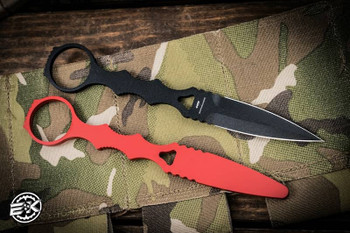
For a Benchmade knife that's a modern example of a dagger-like design built for tactical precision, look no further than the SOCP Fixed Blade. Its sleek, spear-point blade reflects the same balanced, dagger-inspired geometry that made these knives ideal for last-resort carry.
Daggers offer a blend of history and modern engineering that continues to impress collectors and users alike.
Design Features That Define a Boot Knife
If you are trying to spot a true boot knife while shopping, here are some characteristics to look for:
- Blade Length: Usually three to five inches, compact enough for concealment
- Blade Shape: Dagger-style (spear-point or double-edged) for ambidextrous use
- Handle: Slim, grippy, and non-slip, often with a pronounced guard for safety
- Sheath: Designed with a boot clip or discreet belt option
The focus is on utility and speed. A well-designed boot knife should be easy to reach, secure in its sheath, and ready for action at a moment's notice. Whatever your plans and environment for the day, a boot knife should feel like a natural extension of your gear, not a cumbersome extra.
When and Why You Might Want a Boot Knife
A boot knife makes a perfect backup blade for tactical, outdoor, or emergency use. Small enough not to weigh you down, yet capable enough to handle serious tasks, it's a versatile tool in any setup. Hikers and hunters often carry one for field dressing, cutting cord, or quick tasks like cutting gauze or freeing a snagged pack strap.
Boot knives also shine in self-defense scenarios because of their fast-draw potential. Laws regarding fixed-blade knives and double-edged blades vary, so always check your local rules before carrying one in public. Even when intended for utility, understanding regulations is crucial to staying on the right side of the law.
For many, the appeal of a boot knife lies in its reliability. Unlike folding knives, there's no risk of mechanical failure when you deploy it. You always have a sharp, dependable tool ready when you need it most.
Picking the Right Boot Knife
There's no one-size-fits-all boot knife. Start by thinking about your intended use: do you want something ultra-light for camping, or a dependable tactical blade for law enforcement or personal defense? Consider how you'll carry it—ankle sheath, boot clip, or waistband—and make sure the sheath system supports your plan.
Other factors to weigh:
- Steel Type: High-carbon steels like 1095 are tough but need maintenance. Stainless steels, such as AUS-8 or D2, resist corrosion better.
- Blade Grind: Flat or hollow grinds excel at slicing. Thicker grinds add durability for piercing or prying.
- Ergonomics: A compact handle is essential, but comfort is equally important. Look for grips that lock in your hand without adding bulk.
When shopping online, zoom in on photos and read user reviews. Real-world feedback can tell you how a knife draws, carries, and holds an edge over time.
Dagger knives are often referred to as boot knives due to their shared size, shape, and tactical intent. Their classic double-edged blade, compact form, and quick-draw readiness have made them a staple in civilian and military kits.
Today's boot knives honor this history while incorporating modern steels, ergonomics, and carry options. Whether tucked in a boot, clipped to a belt, or kept in a pack, a well-chosen blade delivers confidence and utility.
If you're ready to add a slice of history to your gear, now is the perfect time to step into the world of boot knives. You might just find yourself giving the boot to your old everyday carry or pack knife.
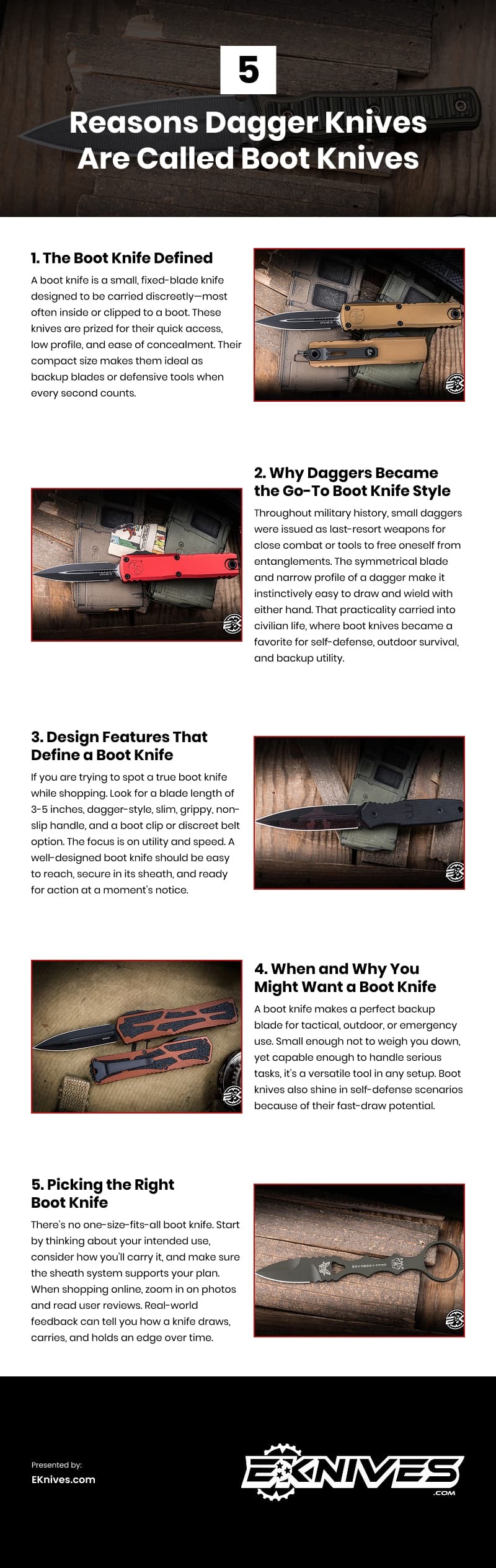
Infographic
Boot knives are compact fixed‑blade knives designed for discreet carry, typically worn inside or clipped to a boot for quick access. This infographic explains why certain dagger‑style knives are commonly called boot knives.