5 Considerations When Choosing Blade Count for a Folding Pocketknife
Posted by EKnives on Jan 20th 2026
When adding a new folding pocketknife to your everyday carry lineup, one of the first questions you'll face is: How many blades do you actually need? For some, a single blade is plenty. That keeps things streamlined and simple. For others, a multi-blade pocketknife offers versatility that a lone blade just can't match. The right answer depends on how you plan to use your new tool, which features you value most, and how you prefer your knives to feel in your hand.
As any knife enthusiast knows, not every folder is built the same. Blade count affects everything from weight and ergonomics to maintenance and function. Before you commit to your next pocketknife, let's slice into the top five considerations for choosing the right blade count for daily use, collection, or adventure.
1. Purpose and Use Case
What do you really need?
The primary factor in choosing a blade count is how you'll actually use your knife. Are you carrying it as part of your EDC, taking it camping, or relying on it for work tasks?
For daily tasks like opening packages, slicing cord, or cutting fruit, a single-blade folder may be all you need. Single-blade models typically feature stronger locks, larger cutting surfaces, and slimmer profiles, making them ideal for quick, reliable performance. They're lighter in your pocket and often deploy faster, giving you instant access when a task demands precision timing.
If you frequently juggle different cutting jobs, a multi-blade pocketknife is like a mini-toolkit in your pocket. Having multiple blade shapes, a clip point, a sheepsfoot, or a pen blade, lets you tackle a variety of materials without swapping knives or constantly resharpening a single edge. For outdoorsmen, craftsmen, and collectors, this versatility is a real edge. Multi-blade knives are preparedness in your palm.
The key is matching the knife to your lifestyle. Lean toward simplicity and durability? Go single. Crave versatility and readiness? Multiple blades will fit that vibe.
2. Design and Ergonomics
What feels comfortable in your hand?
No matter the blade count, comfort is non-negotiable. Extra blades change handle thickness, shift the center of gravity, and can affect balance during use.
Single-blade knives typically have cleaner profiles and better ergonomics, offering a comfortable fit in the pocket and in the palm. This comfort makes precise cuts effortless. Multi-blade knives add layers to the handle, which can feel bulkier, but for quick, versatile tasks, that trade-off is often worth it. Traditional slip joint designs, such as stockman or whittler patterns, incorporate multiple blades without compromising grip or control. Even with extra layers, careful handle design ensures your fingers don't cramp, and the knife still deploys smoothly.
When shopping, hold the knife in your hand. The best one fits naturally, feels balanced, and disappears from your mind until you need it. A knife that hugs your hand instead of fighting it makes every task smoother, and every carry more enjoyable.
3. Weight and Portability
Where is your sweet spot?
Weight can make or break a pocketknife relationship. You want something light enough for comfortable daily carry but substantial enough to handle demanding tasks. Overly heavy knives may weigh down your pocket, while overly light knives can feel insubstantial.
Single-blade knives are usually lighter, taking up less pocket space and reducing bulge while staying quick to deploy. Their more subtle profile may also be better for concealed carry. Multi-blade knives carry extra ounces, but the bonus is a broader range of tools ready for action. Think of it like comparing a screwdriver to a multitool; the latter may be heavier, but it provides more utility.
Finding the right balance depends on your priorities. If comfort and pocket invisibility matter, single-blade wins. If preparedness and versatility drive your carry, a little extra heft is a small price to pay.
4. Maintenance and Durability
Do you want more blades or less care?
The more moving parts, the more attention they need. Multi-blade knives have extra pivots, springs, and liners that require cleaning and lubrication.
A single-blade knife is quick to maintain. You wipe it down, sharpen it, oil the pivot, and you're done. Multi-blade knives demand more patience. You'll need to clear debris from tight spaces, polish edges, and tune each pivot. That takes time, but it's part of the ritual of ownership. Regular maintenance ensures smooth deployment, strong locks, and long-lasting performance.
Maintenance matters when it comes to keeping your knife ready for action for years. Buying quality knives in the first place, no matter how many blades, will also keep them at the forefront of your collection long term. It's helpful to know where to buy pocket knives built to last. High-quality sources make it easier to find knives worth maintaining, polishing, and showing off in your collection.
Durability also matters. Each blade adds stress to the handle and pivot points, so quality materials and craftsmanship are crucial. If you enjoy keeping your tools in peak condition, a multi-blade knife can be incredibly rewarding. Prefer a no-nonsense workhorse? A single-blade folder keeps you efficient, stress-free, and always ready for immediate action.
5. Aesthetic and Collectibility
What's your knife personality?
Knife collecting is about the joy of ownership. The look, feel, and craftsmanship of a knife speak volumes.
Single-blade knives tend to be sleek, modern, and minimalist. That makes them appealing to those who appreciate precision engineering and contemporary design. Multi-blade knives, however, often bring a sense of nostalgia and craftsmanship. Classic patterns like the Case Trapper or Stockman each tell a story, with every blade designed for a distinct purpose. Collectors prize these knives for their heritage, artistry, and versatility.
The personality of the knife also depends on factors outside blade count. Quality and design approach matter, too. Benchmade pocket knives are a prime example of engineering and design excellence. Their single- and multi-blade knives strike a balance between practicality and style, making them a standout addition to any collection.
Whether your collection leans modern and tactical or traditional and historic, the right blade count adds both utility and character. A well-chosen folder not only performs its tasks but also becomes a conversation starter and a collectible item. Investing in high-quality materials and trusted brands ensures that each knife can withstand the test of time and repeated use.
The Final Cut
The right blade count is about the one that fits your hand, your needs, and your lifestyle. Single-blade knives offer simplicity, speed, and durability, while multi-blade folders deliver versatility, craftsmanship, and a sense of nostalgia.
Every knife tells a story, and the number of blades it carries is part of that narrative. Consider what matters most in your everyday carry: lightweight efficiency or multi-function versatility? Are you seeking a workhorse for daily tasks, or a collectible with layers of history and utility?
With the right blade count, design, and craftsmanship, your next folding pocketknife will feel like a true extension of your hand and your style.
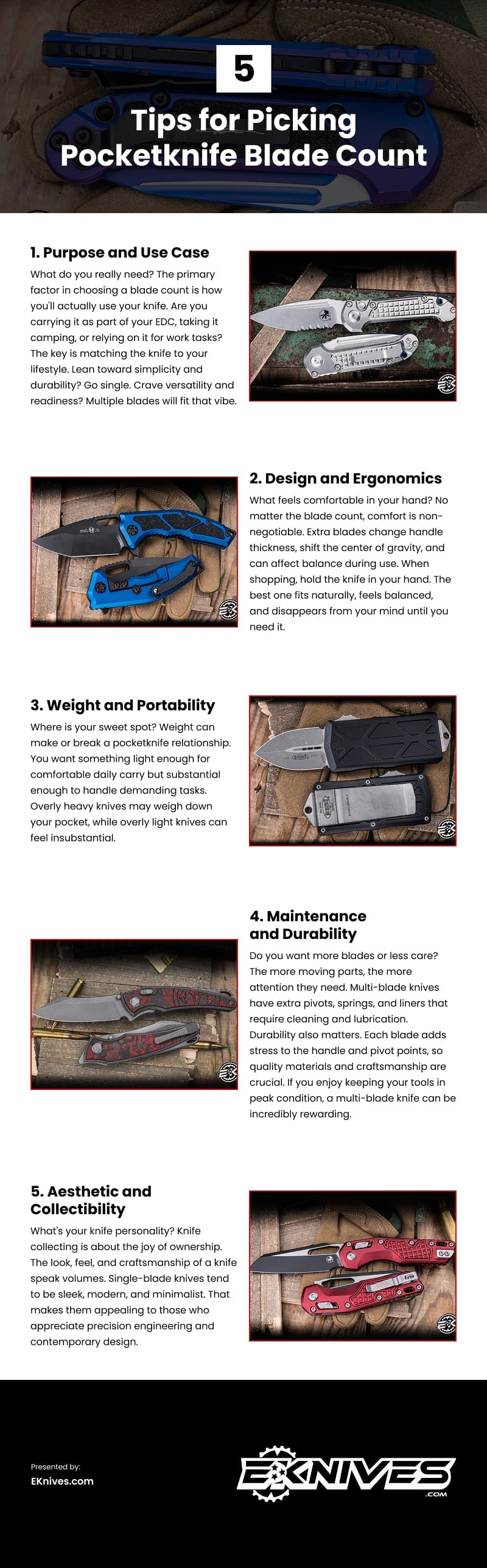
Infographic
Knife enthusiasts know that not all folding knives are the same. Blade count affects weight, ergonomics, maintenance, and function. Before choosing your next pocketknife, check out the top five factors to consider for daily use, collecting, or outdoor adventures in this infographic.