
Tomahawk vs. Hatchet: Know the Difference Before You Buy
Posted by EKnives on Aug 18th 2026
Walk into almost any outdoor gear shop and you'll find tomahawks and hatchets hanging out side by side like they're interchangeable twins. Same general shape. Same "this will chop things" energy. Same aisle. It's easy to assume they're basically the same tool with a different attitude.
That assumption is where a lot of gear regrets start.
While they may look related at a glance, these two tools were forged with very different intentions. They come from different histories, solve different problems, and behave very differently once you actually put steel to wood. Knowing the difference doesn't just help you shop smarter. It keeps you from showing up at camp with the wrong blade and wondering why everything feels slightly off.
You'll find plenty of hatchets and tomahawks for sale. If you're deciding which one belongs in your kit, it helps to understand what you're really looking at before you commit.
Same Category, Different DNA
Tomahawks and hatchets both live in the "single-handed axe" family, but that's about where the shared personality ends.
The tomahawk has roots in Native American toolmaking and frontier-era adaptation. Early versions were simple stone tools, which evolved into iron heads through trade and cultural exchange. Over time, the tomahawk became more than a tool. It showed up in conflict, diplomacy, and survival scenarios where versatility mattered more than specialization. It wasn't just something you used. It was something you carried because you didn't know what the day might demand.
The hatchet comes from a more straightforward lineage. Think European forestry, settlers, and working woodsmen who needed a compact chopping tool they could carry without strapping a full axe to their back. The hatchet's job was practical from the start. Split kindling. Limb branches. Drive stakes. Repeat as needed until the fire is going and camp is set.
One tool evolved with flexibility in mind. The other evolved with repetition in mind. Both earned their place the hard way, just in very different environments.
How the Design Tells the Story
At a glance, you might miss the differences. Put them side by side, though, and the design philosophy starts to show.
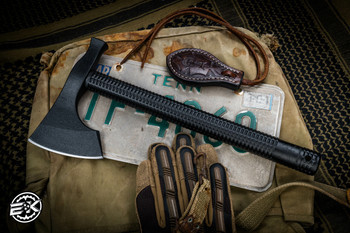
A tomahawk head is usually thinner and lighter. Many feature a spike or hammer poll on the back, giving them multiple ways to solve a problem. The blade is often slightly curved and designed for versatility rather than brute splitting force. It can cut, pry, hook, or puncture depending on the task. It's the kind of tool that doesn't mind improvising a little.
A hatchet, on the other hand, looks like it's here to get work done and go home. The head is heavier and wedge-shaped, built to drive force straight into wood and split it apart along the grain. That geometry means the tool is doing most of the work for you during repeated chopping. Less finesse, more force transfer.
Handle design reinforces the split in personality. Tomahawks often have longer handles to generate swing speed and control. Many modern versions use synthetic materials to absorb shock and reduce weight. Hatchets typically have shorter, sturdier handles that prioritize control over reach. They're built for accuracy and repeated impact, not wide arcs.
One more structural difference worth understanding: the eye. The eye is the opening in the head where the handle passes through. Traditional tomahawks often use a tapered eye that allows the head to be removed and replaced, which matters both for historical throwing applications and for field maintenance when you're far from a hardware store. Most modern hatchets use a fixed, permanently attached head, because a hatchet that separates mid-chop at a campsite is a safety problem nobody wants to deal with at dusk.
Even the way they feel in your hand tells you something. A tomahawk feels a little more agile. A hatchet feels like it wants to stay put and get to work.
What Each Tool Does Best
This is where the difference really shows up in practice.
A tomahawk shines when versatility matters. It can handle light chopping, prying tasks, and utility work. Some designs are also used for throwing, which adds a completely different skill set into the mix. Competitive throwing is a real discipline, and a well-balanced tomahawk behaves very differently in flight than a traditional hatchet ever could.
Modern tactical tomahawk designs take that versatility even further. They're built for real-world use cases like breaching, cutting cordage, and general utility work where adaptability matters more than brute force. You'll also see them designed with durability in mind, because a tool that might be used in high-impact situations can't afford to be fragile.
Hatchets, meanwhile, are all about camp work. If you need to process firewood, split kindling, or limb branches for a fire ring, a hatchet is in its element. The heavier head makes repeated chopping more efficient, especially when you're doing it for longer stretches. It's less about versatility and more about rhythm. Swing, bite, reset, repeat.
Spend an hour processing wood with a good hatchet and you'll understand why people trust them. They don't ask questions. They just work.
Where things get messy is when people assume one can do everything the other does. A hatchet can technically do light utility work, but it's not going to behave like a tomahawk in a throwing or tactical context. A tomahawk can chop, but it's not going to split wood with the same efficiency over time. That's where frustration creeps in.
Wrong tool, wrong job, wrong mood.
Choosing the Right One for Your Kit
Picking the right tool comes down to what you actually plan to do with it, not what looks coolest in an online listing.
If your time is going to be spent setting up camp, processing wood, and handling steady outdoor chores, a hatchet is the straightforward choice. Look for something in the 14 to 16 inch range for one-handed use, with a head weight around 1.5 to 2 pounds. That combination tends to balance control and efficiency without overworking your wrist.
If your kit leans more toward versatility, utility tasks, or you want a tool that can handle a wider range of situations, a tomahawk fits that role better. It will solve a wider range of problems, but if you ask it to do hours of wood chopping, you're going to work a lot harder than you would with a hatchet.
Within each category, there's a variety of designs, so you can narrow even more based on your intended use. Browse listings at your favorite online knife store so you can compare designs, steel types, and handle materials before choosing what fits your setup.
Many experienced outdoors folks don't pick one or the other. They carry both. Because once you understand what each one does well, it's obvious they aren't competing tools. They're complementary ones. It's like having both a screwdriver and a wrench in your toolbox. One isn't better than the other; they just do different things.
The Bottom Line
Tomahawks and hatchets aren't interchangeable, even if they like to pretend they are when they're hanging on the same rack in a store.
One is a flexible, adaptable tool with roots in versatility and tactical use. That's the tomahawk. The other is a dedicated workhorse built for consistent chopping and camp efficiency. That's the hatchet. They overlap just enough to confuse people, but diverge enough that using the wrong one becomes obvious very quickly.
Once you understand that, shopping gets easier, your loadouts get smarter, and your time outdoors gets a lot less frustrating.
In the end, it's less "which is better" and more "which problem am I solving right now."