
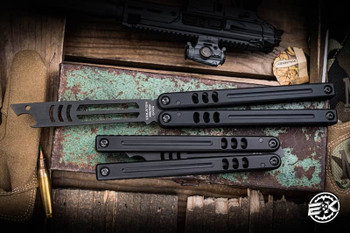
What Sets Collector vs. Flipper Balisongs Apart
Posted by EKnives on Sep 24th 2026
A balisong is many things. It's part mechanical puzzle, part performance tool, part collector's trophy: no other knife type manages to be so many things to so many different people at once. That versatility is most of the appeal. It's also where buyers are most likely to end up with a butterfly knife that doesn't do what they'd hoped as well as they'd hoped.
The question that clarifies everything is simple: Are you buying to flip it or to frame it?
The answer determines which materials matter, which features to prioritize, how much you should reasonably spend, and whether you'll look back on the purchase with satisfaction or regret. Collector balisongs and flipper balisongs are built around fundamentally different priorities. Learn those priorities before you start shopping, and you'll avoid a very expensive lesson in buyer's remorse.
Collector Balisongs Are Built to Be Admired
Scroll through any batch of collectible knives for sale and there's probably a beautiful balisong or two. These are knives where the materials, the maker, and the provenance matter as much as the mechanical function, and in many cases more.
Materials
Materials are where collector balisongs earn their first edge. Mokuti handles, carbon fiber inlays, anodized titanium with complex pattern work, and hand-ground Damascus blades are not the specifications of a knife anyone plans to run through 1,000 aerial catches. They're the specifications of a knife you acquire carefully, store properly, and handle considerably less than you might like. Every scratch on a collector balisong is a permanent record of a choice you can't take back, which is exactly why some of the best ones never leave their case.
Numbered or Limited Pieces
Limited production runs and numbering add another layer. A numbered piece from a respected maker carries a rarity premium that has nothing to do with how well it flips and everything to do with how few exist.
Maker Reputation
Maker prestige operates the same way. In the balisong community, certain custom makers command significant premiums based on craftsmanship and waiting lists rather than mechanical performance alone. Know those names, and what they represent. That's what separates a sharp buyer from someone who just overpaid for a knife that will disappoint them.
The investment angle is legitimate but not guaranteed. Highly sought-after collector balisongs can hold their value or appreciate meaningfully over time. A numbered, limited edition from a respected maker is a different kind of purchase than a production knife, and the secondary market often reflects that. Condition is everything here. A collector piece with handling wear or missing its original packaging loses value fast.
With collector balisongs, fitment is precise, blade play is minimal, handles align correctly, and the overall build communicates care at every contact point. The irony is that many of these knives never experience the kind of use that would reveal how well they're actually made.
Flipper Balisongs Are Built for Handling
A flipper balisong means business, and every engineering decision on it reflects that. Pivot type, weight distribution, handle geometry, tang pin placement: each of these specifications exists in service of one goal, which is smooth, repeatable action that holds up through serious use.
Balance
Balance is the flipper's most critical spec. Neutral weight distribution between the blade and handles means the knife tracks predictably through tricks, completes rotations cleanly, and responds consistently to the user's hand position on the catch.
Even small imbalances compound across rotations, revealing themselves through inconsistent action and difficult catches. Collector balisongs often have beautiful weight distribution that their owners never actually test. Flipper balisongs are built so that distribution is functional rather than incidental.
Pivots
Pivot construction separates serious performance flippers from the rest. Bushing pivots have been the standard for performance flipping for decades. They're durable, tunable, able to maintain their action over time, and straightforward to service as they wear. Bearing pivots offer faster initial action but require more maintenance and are more sensitive to debris infiltration. Both are legitimate choices depending on how and where you flip, and quality versions of either will outperform budget alternatives by a significant margin.
Handles
Handle materials on quality flippers prioritize durability and grip. Titanium is the premium choice. It's tough, dimensionally stable, and light enough to keep weight distribution neutral across the whole knife. G10 handles appear on training-oriented balisongs and at lower price points, and they'll take a beating that would leave titanium sulking.
No matter the material choice, good flipper handles are designed to be gripped, worn in, and used. That's a different philosophy from a collector display piece, and it shows in how each type ages.
Break-In
Most quality flippers take some time to hit their stride. Tight pivot tolerances and new contact surfaces benefit from repetitions to settle into their final action. A flipper that feels slightly stiff on day one often develops a noticeably smoother feel after a few hundred flips. This is expected and normal, and it's entirely unlike the experience of owning a collector balisong that no one would ever run through a break-in period.
Where the Line Gets Blurry
Some balisongs refuse to pick a lane, and the knife community tends to be enthusiastic about them precisely for that reason.
Premium production flippers from established manufacturers develop collector followings without changing anything about how they perform. Limited-run colorways, special anodizing, and regionally exclusive finishes can turn a purpose-built performance knife into a sought-after collector's item. Secondary market prices on these hybrid releases often reflect demand that had nothing to do with flipping performance and everything to do with scarcity.
Custom makers who build to flipper specifications command collector-level prices. These are knives with the balance and action of a performance tool and the craftsmanship and rarity of a display piece. They are also among the hardest balisongs to source and the longest to wait for. If you own one, actually flipping it daily takes a specific comfort with using expensive things as intended, and with the value hit that can follow.
The situation to avoid is acquiring a genuine collector piece and then deciding to learn tricks on it. A few sessions of serious practice will leave marks on handles, introduce wear at pivot surfaces, and reduce collector value in ways that are difficult to reverse. Collector balisongs tolerate heavy use poorly because they were never built to tolerate it at all. The reverse is also true. A hard-use flipper isn't going to hold secondary market value like a numbered limited edition, so don't expect it to.
What to Know Before You Buy
Before browsing balisong knives for sale, clarify your intent. The market will happily sell you either type without always making the distinction obvious, and the specs that matter most to a flipper are largely irrelevant to a collector, and vice versa.
Start with an honest question: Are you going to practice with this knife? If the answer is yes, a purpose-built flipper is the right starting point. Flipper balisongs are designed for use, and a quality performance flipper at a reasonable price will teach you more about the mechanics and your own preferences than a collector piece you're reluctant to touch. Once you understand what you're looking for in feel and action, adding collector pieces to the mix makes considerably more sense.
Budget doesn't cleanly separate the two types. Collector balisongs can be expensive, but not all expensive balisongs are collector pieces, and some of the best performance flippers carry premium price tags based on tolerances and materials rather than rarity. Read the specs rather than the price: pivot type, weight distribution, production run size, and handle construction tell you more about what a balisong is built for than the number attached to it.
Sourcing matters more with balisongs than with most other knife categories. The gap between a well-built production flipper and a soft-metal imitation can be difficult to identify from product photos alone, and the collector market has counterfeits. Buy from dealers who know balisongs, can cut through the noise of vague listings, will speak to the construction details, and stand behind what they carry.
Finally, check your local laws before purchasing. Balisongs carry specific legal restrictions in several U.S. states and many international markets. Know the legal landscape before you buy. That way, when you buy something sharp, you're also buying smart.
Know Your Edge Before You Buy
Collector and flipper balisongs exist in the same category but answer completely different questions. One is built for the case or the safe; the other is built for the hand. The sharpest buying decisions start with knowing which question you're actually trying to answer.
Answer that question honestly and thoroughly, and the rest sorts itself out. The materials, the price, and the specs worth caring about all stop being guesswork once you know whether you're buying to flip it or to frame it.