
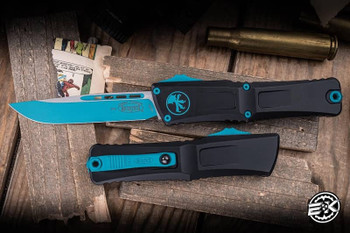
Why Sci-Fi Heroes Would Buy Microtech Knives
Posted by EKnives on Sep 15th 2026
The gear of science fiction is spectacular. Plasma rifles, vibro-blades, energy swords, and neural disruptors: the future has never had a shortage of ways to handle extraordinary threats. But somewhere in every great sci-fi hero's kit, there's always a blade. Not the flashy kind. The reliable kind. The one that still works when the power cells run dry, aliens are beating down the spacecraft hatch, and the tech fails.
If sci-fi heroes went knife shopping in a non-fiction store, we bet they'd buy Microtech knives.
Microtech knives are built to a standard that feels less like contemporary manufacturing and more like something borrowed from a prop department, except they actually work. Microtech gear seems like future tech you can find at an online knife store today, instead of having to wait until the 22nd century.
Let's look at what makes Microtech knives so future-ready, and what four of science fiction's greatest characters would have clipped to their kit.
Why Microtech Already Feels Like Future Tech
Start with the OTF (out-the-front) mechanism. Press a button, and the blade fires forward through the handle with a clean, mechanical snap. There's no folding, no manual pull, no secondary motion. One button, one result. In a sci-fi context, that simplicity reads as advanced technology. In the real world, it's precision engineering. Both descriptions are accurate.
Then there are the materials. Microtech builds handles from aircraft-grade aluminum and uses high-alloy blade steels held to strict heat-treatment tolerances. These are materials with legitimate aerospace applications, not marketing language dressed up to sound impressive.
The design language finishes the picture. Clean lines, muted profiles, and flush hardware give Microtech knives a visual precision that looks purposeful even sitting still on a table. They photograph like props. They perform like tools. That's the combination every great piece of sci-fi gear aspires to pull off.
When real-world engineering reaches a point where it needs to be seen to be believed, it stops being just a tool and starts being a statement about what's possible. Microtech landed there some time ago.
Boba Fett Would Carry Microtech's Combat Troodon
Boba Fett doesn't experiment with gear. He uses what works, wears what survives, and carries what performs under pressure. His kit is the product of hard experience across some of the worst environments in the galaxy: vacuum exposure, desert heat, and the decks of whatever ship he's hunting across this week. Every piece earns its place through performance, not appearance.
The Combat Troodon fits right in.
Microtech's largest production OTF, the Combat Troodon, is built for serious use in a way that communicates its purpose immediately. The blade profile is aggressive but precise. The aluminum body is substantial without adding dead weight. It deploys with authority and locks up with zero tolerance for slop. The double-action mechanism cycles clean regardless of what's coating the exterior: sand, grit, or whatever Tatooine throws at it.
The Combat Troodon is purpose-built for users who carry with intention and maintain with discipline. That's Boba Fett. He doesn't reach for something because it looks right. He reaches for something because it performs right, in conditions that break lesser equipment. Aboard a Star Destroyer or in the middle of a desert standoff, the Combat Troodon deploys clean. That's the standard Boba Fett would require.
Neo Would Keep an Ultratech Close
Neo operates in a world of perfect form. Every movement he makes inside the Matrix is a calculation: a precisely executed sequence with no wasted motion. He doesn't improvise. He processes. In a universe built from lines of code and impossible precision, the only real-world blade that fits his operating logic is Microtech's Ultratech.
The Ultratech is the definitive Microtech design. Slim, balanced, and as close to perfect OTF geometry as the category produces. The deployment is smooth. The lockup is immediate and holds without play or rattle. Nothing about it is excessive or decorative. It's a knife stripped of every non-essential element, keeping only what functions. The blade deploys in a single motion, the grip lands exactly where it needs to, and the hand doesn't have to adjust.
Neo carries what's optimized. The Ultratech fits that logic exactly. In or out of the simulation, it's the right tool for someone who has zero patience for anything that doesn't perform at the highest possible level. The agents won't see it coming. The precision is real.
Ripley Would Trust the UTX-85
Ellen Ripley doesn't carry anything she can't count on. She's survived xenomorphs, corporate betrayal, and deep-space disasters. And she's survived those not because she had unlimited resources, but because she knew how to use what she had and never picked tools that would let her down. When everything goes sideways, Ripley falls back on reliable.
The UTX-85 is reliable.
Smaller and lighter than the Ultratech, the UTX-85 packs Microtech's OTF precision into a more compact frame. It doesn't need to be the biggest blade in the room. It needs to be the blade that's there when you reach for it: clean deployment, secure lockup, no drama. For someone navigating tight corridors in a pressure suit with minimal storage space, a compact footprint matters. The UTX-85 stays out of the way until it's needed, then does its job without ceremony.
Ripley would pick the UTX-85 because it doesn't make promises it can't keep. It's the blade for getting back to the ship, not for making a statement. The UTX-85 would be clipped to her belt and left there. When the situation calls for a blade, it deploys. That's all Ripley needs from a tool. In the Alien franchise and in her hands, that tends to be enough.
Deckard Would Reach for the Halo VI
Rick Deckard exists in a world that's technologically advanced and completely exhausted at the same time. Los Angeles in 2019 (or 2049, depending on which chapter of the story you're in) is a city of layered surfaces: neon over concrete, rain over grime, artificial life over decaying infrastructure.
Deckard navigates it all with a worn-in practicality that has no patience for flash. That's why he'd carry the Halo VI, which has no patience for flash either.
Microtech's Halo VI is a large-format OTF with a presence that commands attention without working for it. Push the button, and the blade comes out. The mechanism is direct in a way that suits a character who's been around long enough to value function over theater. The size gives it gravitas. The build quality gives it longevity. It's the kind of tool that looks like it belongs to someone who's made a considered choice rather than a quick one.
Blade Runner is, at its core, a story about what endures. The Halo VI would endure a night in 2049 Los Angeles. It would survive the rain, the close quarters, and the kinds of places Deckard ends up when no one's looking for him. In a city that chews through most things and spits them out broken, a piece of honest engineering that holds its edge stands out. For Deckard, that's the only qualification that matters. And that's his Halo VI.
A Blade for Every Galaxy
Microtech knives weren't designed with fictional characters in mind. They were built for the real world, for users who need precision engineering and won't accept performance that degrades when conditions get difficult. The fact that they map so cleanly onto the demands of heroes living in impossible circumstances reflects how seriously Microtech takes the craft.
For collectors, EDC enthusiasts, and gear-obsessed sci-fi fans, the Microtech lineup delivers the same design intentionality that their favorite heroes rely on to stay alive and stave off destruction. Your daily commute is considerably less dramatic than anything Ripley ever faced. Your ideal blade might still be the same as hers.