Why the Bowie Blade is Built for Use and Not Just for Show
Posted by EKnives on Jul 21st 2026
Walk into any room with a Bowie knife on the table, and you'll know it immediately. The long profile, the clipped tip, the substantial handle. A Bowie has presence.
That commanding look leads many people to assume the Bowie is mostly about aesthetics. They think it's a showpiece dressed up in historical swagger. But this blade didn't earn its legendary reputation by sitting on a shelf and looking pretty. It cut its way there.
If you're eyeballing listings for tactical or survival knives for sale, trying to decide whether a Bowie deserves a spot in your kit, the best answer is that this design has serious working credentials. It brings reach, control, and cutting power together in a single package.
Once you understand how the shape actually functions, the whole thing starts to make a lot more sense as a genuine tool rather than just a conversation piece. (But you'll probably love talking about it almost as much as you love using it.)
The Blade Shape Has a Job to Do
That classic Bowie profile isn't accidental. Every curve and angle on this knife exists because it solves a problem. The long cutting edge delivers real slicing power. The clipped point gives you precise tip control. And the overall size gives you leverage when you're working through tougher material around camp or on the trail.
That clip point deserves some extra attention, because it's one of the Bowie's most underappreciated features. It creates a sharper, more refined tip than you'd get with many broader survival blades. When you need to make controlled cuts, pierce tough material, or work in tighter quarters, that tip is doing you a major favor.
Meanwhile, the belly of the blade gives you enough curve for clean, efficient slicing. It's a design that really knows how to handle itself.
That combination of precise tip, strong belly, and long edge is exactly why the Bowie has lasted for roughly two centuries. It covers multiple tasks without feeling clumsy doing any of them. That's not an accident. That's good engineering.
A Bowie Handles Outdoor Work Like a Champ
You're heading into the field with one knife, and you need that knife to do several different jobs. Clear some light brush, cut cord, prep kindling, slice food, handle whatever general camp work comes up. A smaller blade can handle some of that. A Bowie can, too, plus it gives you more authority when things get heavier.
The added blade length is a real asset when you need longer draw cuts. The extra weight pulls its own weight (pun fully intended) during chopping and rougher utility tasks. You still need solid technique. No knife does the work for you, but the Bowie gives you more to work with than a compact fixed blade when the jobs get demanding.
That's a big reason people keep coming back to this pattern. Carry one knife, feel fully prepared for a wider mix of tasks. It's the kind of versatility that makes you feel like a sharp thinker before you've even made your first cut.
Don't Sleep on the Handle and Guard
A great Bowie blade means nothing if the handle isn't up to the job. Fortunately, the design has always taken this seriously. Most Bowie knives are built with enough handle length to support a secure, confident grip even when your hands are wet, cold, or gloved.
A large blade absolutely demands control. A slippery grip with a big knife isn't just inconvenient; it's a recipe for a bad day. Most Bowie handles give you the control you need to keep things safe and secure during hard use.
Many Bowies also include a guard, and that feature is worth more than people sometimes give it credit for. When you're really putting pressure on a cut, the guard keeps your hand in place. It adds safety during harder work and gives the whole knife a much more planted, purposeful feel in hand.
Compare a well-made Bowie to a cheap oversized knife with a poor handle shape, and you'll feel the difference in about 10 seconds flat. One feels like a serious tool. The other feels like an accident waiting to happen. The Bowie's handle geometry, when done right, is part of what makes the whole package click.
Why Big Knives Usually Disappoint (And Why the Bowie Doesn't)
There's a lot of dramatic, oversized cutlery out there that looks intimidating in photos and underperforms in the field. Blades too thick to slice cleanly. Handles too awkward to control. Balance points that make every task feel like a struggle.
These knives look like they mean business, but they can't actually handle business.
A good Bowie sidesteps all of that by balancing size with smart geometry. You get a blade that feels substantial without turning every simple task into an ordeal. You can still slice cleanly, you still get the extra reach and power that justify carrying something larger, and you're not fighting the knife every time you pick it up.
If you've ever wrestled with a heavy camp knife that felt like overkill for everything except splitting logs, you already understand what the Bowie does differently. It stays versatile. It stays usable. That's a hard trick to pull off, which is why so many knives get it wrong. The Bowie gets it right.
Steel and Grind Are Where It Gets Real
The Bowie pattern is proven, but no pattern saves a poorly made knife. The best blade geometry in the world won't bail you out if the steel is mediocre, the heat treat is off, or the grind can't slice worth a lick.
If you're shopping for a Bowie you actually plan to use, here's what to focus on:
- Blade steel that matches your environment and maintenance habits
- A grind that can still slice, not just look thick and tough
- Handle material with real grip and durability
- A sheath that carries securely and draws cleanly
These details are the difference between a Bowie that becomes a trusted part of your kit and one that collects dust after the first few uses.
The Bowie Still Earns Its Place Today
Modern knife buyers have more options than ever. Compact, tactical, minimalist, ultra-specialized: the market has it all. Yet the Bowie keeps its following because it solves real problems well. It's a large fixed blade with genuine versatility and the kind of working utility that justifies its size.
That's why searching for a Bowie knife for sale isn't just a trip down nostalgia lane. This is a blade shape that has survived not because of legend, but because it keeps delivering. Plenty of designs have come and gone over the years, but the Bowie keeps cutting through the competition.
It won't replace every tool in your kit. Nothing does. But if you choose a well-made one and learn how to use it properly, you might be surprised just how sharp an investment it turns out to be.
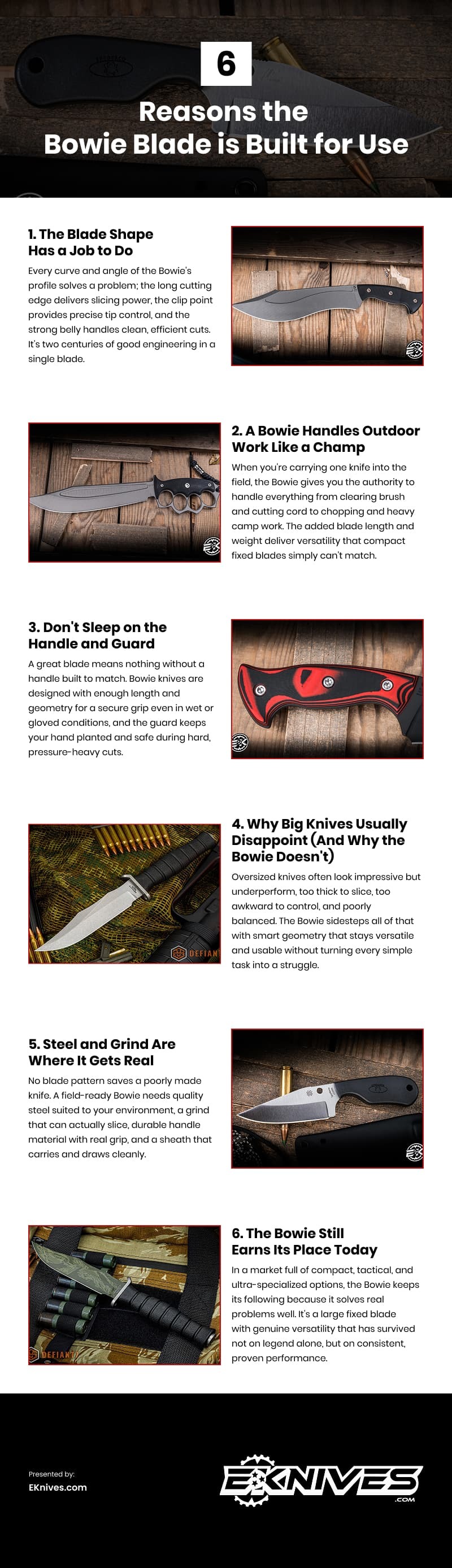
Infographic
The Bowie knife has earned its reputation over nearly two centuries not through legend, but through genuine working performance and versatile design. Check out the reasons the Bowie blade is built for use in this infographic.