How Benchmade Keeps Cutting in Extreme Environments
Posted by EKnives on Sep 10th 2026
Some knives you see listed at an online knife store look great in a display case. Beautiful knives have a place; we love them as much as the next blade enthusiast. But sometimes, you need more than a pretty tool. When you're headed to the field, you need gear designed to work when everything else is fighting against it. Extreme environments make quick work of sorting the pretty faces from the reliable workhorses. Knife mechanisms that operate smoothly on a mild afternoon can seize, jam, or fail when temperatures drop and conditions deteriorate.
Cold seizes up springs and stiffens lubricants. Mud and sand infiltrate locking mechanisms and jam blade travel. Salt air accelerates corrosion. Moisture swells handle materials and compromises the fit between scales and tang. Any one of these conditions can turn a poorly engineered knife into an unreliable tool at the exact moment you need to count on it.
Benchmade builds for these conditions. Their locking mechanisms, deployment systems, blade steels, and handle materials all reflect deliberate choices about specific failure modes. Understanding what they get right starts with understanding what extreme environments actually break. That starts with the lock.
Benchmade's Axis Lock Doesn't Care About Dirt or Cold
The Axis Lock is the foundation of Benchmade's folding knife reliability story. It operates through a spring-loaded bar that moves perpendicular to the blade, snapping into a notch in the blade's spine to hold it open under load. That geometry creates a self-adjusting mechanism. As internal components wear over time, the Axis Lock maintains solid lockup without requiring extremely tight manufacturing tolerances to compensate.
In normal conditions, that's a durability advantage. In extreme environments, it becomes more significant.
Traditional liner locks and frame locks rely on precise metal-to-metal contact between the lock face and the blade tang. As grit, sand, or fine debris works into that contact zone, lock degradation follows.
The perpendicular bar design of the Axis Lock that Benchmade builds into its folding lineup is inherently less sensitive to debris intrusion. The spring-loaded bar seats into a notch, and debris that infiltrates the mechanism doesn't prevent engagement the way it compromises flat-contact locking systems. Sand and grit that would cause a liner lock to slip off-center simply settle around the bar without disrupting its ability to seat.
Cold temperatures add another layer of stress. Springs stiffen. Lubricants thicken. Contact surfaces bind. The Axis Lock tolerates these conditions because its geometry maintains consistent spring tension across a range of temperatures. You can run the large, ambidextrous actuation bar with gloves on and fingers made clumsy by the cold. Smaller, thinner lock interfaces don't always allow that.
For field use in cold weather or dirty conditions, those are not marginal differences.
Benchmade's Automatic Models Are Engineered to Deploy Clean
Automatic knives introduce a more complex set of engineering demands than manual folders. Spring-loaded deployment systems have more potential failure points, and extreme conditions stress each of them. Cold thickens lubricants and reduces spring tension. Sand and debris infiltrate the firing channel. Ice can physically block blade travel.
Benchmade addresses these vulnerabilities through precision machining of the firing channel, the enclosed path through which the blade travels during deployment. Tight tolerances minimize debris accumulation and maintain consistent blade movement after exposure to dirt, sand, or wet conditions that would cause a looser-toleranced design to hesitate or fail.
The coil springs in Benchmade's automatic models are selected for consistent performance across a wide temperature range. A spring that loses significant tension at 20 degrees Fahrenheit introduces inconsistency into the deployment cycle. The springs Benchmade uses maintain their characteristics through the temperature swings that outdoor and tactical field use actually produces.
For users carrying automatics in demanding environments, that consistency can be the difference between a useful tool you rely on and a disappointing knife that leaves you stranded. A manual folder that opens stiffly is an inconvenience. An automatic that doesn't fire cleanly is a more serious problem. Benchmade's automatic engineering is built around eliminating that problem, not hoping conditions stay favorable.
The Steels Benchmade Picks for Wet, Cold, and Abrasive Work
Blade steel decides whether your knife holds its edge or folds under pressure in harsh outdoor settings. Three steels appear most often across Benchmade's hard-use lineup: S30V, CPM-3V, and CPM-154.
- S30V offers balanced performance across the variables that outdoor use demands. It gives you solid edge retention, good corrosion resistance, and enough toughness for daily hard use. It's the kind of steel that performs consistently across a range of tasks without demanding specialized care between uses. In wet or salt-air environments, it holds up without requiring constant maintenance or early resharpening.
- CPM-3V leans toward toughness. It's designed to absorb impact without chipping or cracking, which makes it the right steel for knives that will face lateral stress, batoning, or chopping tasks where edge integrity under shock matters more than fine sharpness. When metal becomes brittle in the cold, steels with marginal toughness start to chip at the edge. A tough steel like CPM-3V survives punishment that a harder but more brittle alternative doesn't.
- CPM-154 is the corrosion-resistance selection. Developed as a stainless tool steel, it handles exposure to moisture and salt better than many alternatives while still delivering useful edge retention. For users in coastal environments, wet climates, or situations involving frequent water contact, it's a practical choice.
Benchmade doesn't pick these steels arbitrarily. Each one addresses a specific performance requirement tied to the environments their users work in.
Handle Materials That Don't Crack, Swell, or Give Out
A blade is only as reliable as the handle it's attached to. Handle materials fail in extreme environments in predictable ways: cracking in cold, swelling in humidity, shattering under impact, degrading from UV exposure or chemical contact. Benchmade's material selections address each of these failure modes directly.
- G10 is a fiberglass laminate that resists cracking in cold temperatures, doesn't absorb moisture, and maintains its texture and structural integrity through impact and abrasion. It's dimensionally stable across a wide temperature range, which keeps the fit between handle scales and tang even in rough conditions.
- Aluminum, machined and anodized in Benchmade's designs, offers a high strength-to-weight ratio with excellent resistance to temperature-driven expansion and contraction. It doesn't swell, won't absorb moisture, and holds its shape when the mercury drops.
- Grivory, a glass-fiber-reinforced nylon composite, brings similar performance characteristics: impact resistance, low moisture absorption, and dimensional stability in the cold. It's lighter than aluminum and provides a textured surface that maintains grip even when wet.
Dimensional stability across all three materials matters beyond surface-level comfort. When handle scales shift as temperatures change, the fit between scales, liner, and tang changes with them. On poorly engineered knives, that translates to rattle, loosened fasteners, and reduced structural integrity. Benchmade's material choices prevent that degradation. The fit that leaves the factory is the fit that lasts through seasons of hard use.
Engineered for the Conditions That Test Everything
The reliability of a Benchmade knife in extreme conditions comes down to the cumulative effect of design decisions made at every level. Each choice addresses a specific way a knife can fail when conditions turn hostile.
The locking mechanism self-adjusts and tolerates debris. Deployment systems are machined for consistent performance under stress. Blade steels match specific environmental demands. Handle materials maintain their structural integrity regardless of what the temperature does.
Extreme environments are unforgiving. They expose every weak point in a design. The fact that Benchmade has built a reputation for field reliability reflects choices made specifically because they hold up where shortcuts don't. That's the edge Benchmade builds in, and it's the kind of edge worth carrying.
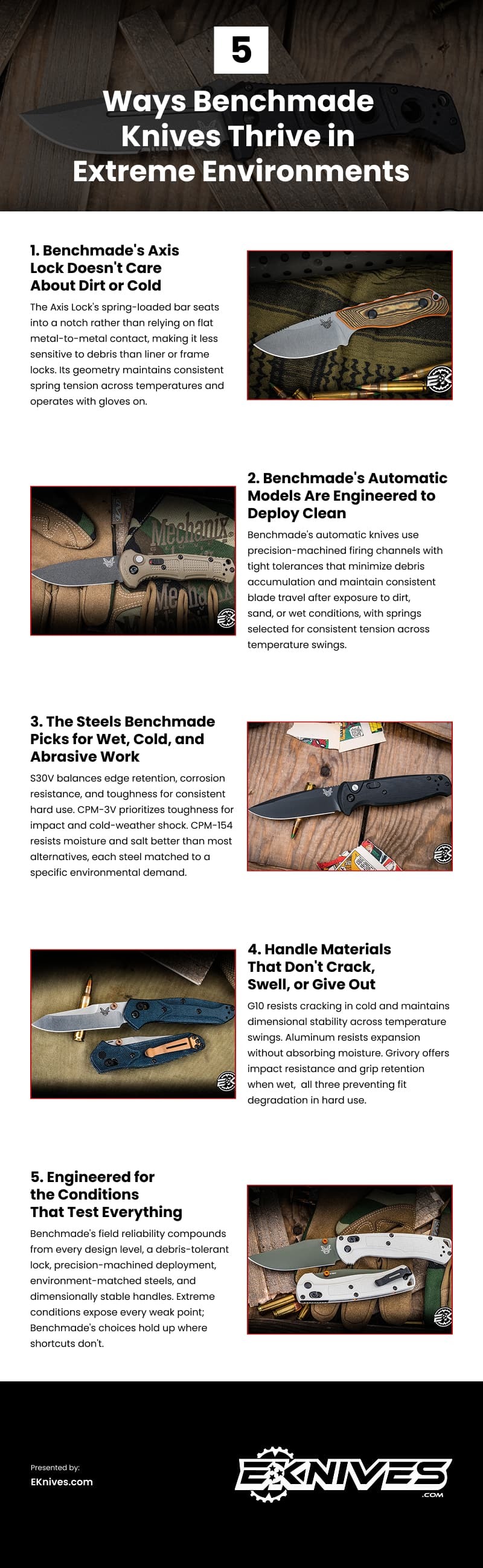
Infographic
Extreme environments quickly sort reliable knives from unreliable ones, and Benchmade's field performance comes from design decisions made at every level of the knife, not from marketing claims. Find out five ways Benchmade knives thrive in extreme environments in this infographic.