How to Identify Rare and Limited Edition Spyderco Knives
Posted by EKnives on Jun 16th 2026
If you collect Spyderco, you already know the fun starts after the first purchase. One knife turns into a pattern. You begin noticing steel choices, handle colors, production runs, and small stamp details that separate a common model from something much harder to find. That shift matters because rare Spyderco knives often reward the collector who pays attention to details others skip.
You do not need to guess your way through it. Rare and limited Spyderco knives usually leave clues. Some clues are obvious, like unusual handle materials or a steel you rarely see in standard production. Others take more effort, like production history, tang stamps, and packaging details that confirm a knife came from a specific run. If you know where to look, you can sort a genuinely collectible piece from a knife that only sounds rare in a marketplace listing.
Learn The Main Types Of Rare Spyderco Releases
Spyderco rarity usually falls into a few recognizable categories. If you understand those categories first, you give yourself a much better chance of identifying what you are actually looking at.
The first category is discontinued models. These knives were once regular production pieces, but Spyderco stopped making them. Some discontinued models stay affordable for years. Others become far more desirable because the design built a loyal following or because the model introduced features collectors still talk about.
The second category is Sprint Runs. These are short-run versions of existing models or occasional one-off releases with special steels, colors, or handle materials. Spyderco fans watch Sprint Runs closely because they often combine proven designs with materials you may not see again on that platform.
The third category includes dealer exclusives and collaborations. Dealer exclusives often use a special steel or a unique handle color tied to one retailer. Collaborations with custom makers can carry design details that stand apart from standard production models and attract a strong secondary market following.
Start With The Steel
Blade steel is one of the fastest ways to tell whether a Spyderco may be special. Standard production models usually stick to familiar steel choices for that model family. When you see steels like S90V, HAP40, or another steel tied to a Sprint Run or exclusive, that should get your attention immediately.
That does not mean every unusual steel equals a gold mine. It means you should stop and verify. If you find a Delica, Paramilitary 2, or Native with a steel that does not match the standard production version, you may be looking at a Sprint Run or a dealer-exclusive release. The steel alone will not prove rarity, but it gives you a strong lead.
This is also where research protects you. Sellers sometimes lean heavily on steel names because they know collectors respond to them. Before you buy, confirm that the steel matches an actual documented release rather than a blade swap or a mistaken listing.
Look Closely At Handles, Colors, And Small Details
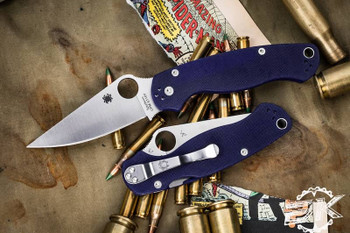
Handle material and color often reveal just as much as the steel. Spyderco collectors know certain shades of G10, FRN, carbon fiber, or special scale materials often tie directly to a limited run. A bright green handle may indicate one dealer exclusive. A burnt orange or deep blue version may point you toward another.
Small details matter here. Hardware finish, backspacer color, blade coating, and engraving can all help narrow down a knife's origin. You want to compare the knife in front of you to known release photos and archived listings whenever possible. Collecting rewards side-by-side comparison more than impulse.
One practical example: if you find a standard Spyderco model with an uncommon steel and a handle color that does not appear in the regular catalog, your odds improve that you are looking at a limited release. If the box label matches that combination, you are getting closer to a confident identification.
Tang Stamps And Production Clues Matter
Tang stamps can tell you a lot if you know how to read them. Spyderco knives often include country-of-origin stamps, steel markings, and model information that help you place the knife correctly. A rare release usually still follows those conventions, but the combination of details can confirm whether the knife lines up with a known Sprint Run or a specific era of production.
Production date codes and packaging labels can also help. Early runs and limited batches often have small differences that longtime collectors track carefully. If you are buying older or potentially discontinued Spydercos, spend extra time here. The knife may look right at first glance, but the wrong stamp or mismatched box can change the whole story.
This is one reason experienced collectors keep reference photos and saved listings. Rare knife identification often turns into detail work. You are building a case, not relying on a single feature.
Research The Production History Before You Buy
Spyderco has released enough variations over the years that memory alone is a bad system. You need production history. That means checking official announcements, old catalog pages, forum archives, collector groups, and any reliable source that documents model changes and short runs.
Spyderco's own announcements are especially useful for Sprint Runs and special releases. They give you the most direct line to what was produced, what steel was used, and how the release was positioned at the time. If you stay alert to official brand communication, you will catch patterns faster and avoid a lot of bad assumptions.
A practical habit helps here:
- Save screenshots or links to verified releases you care about.
- Compare listings against known steel, handle, and model combinations.
- Be suspicious of vague descriptions that use "rare" without any real supporting detail.
Research may feel slow at first, but it gets faster as your mental catalog grows.
Original Boxes And Documentation Add Real Value
If you care about long-term collector value, keep the original box, paperwork, and any inserts that came with the knife. Those extras will not change the knife itself, but they can make resale cleaner and more credible later. They also help you prove a knife's identity if you ever want to sell or trade it.
This matters even more with dealer exclusives and Sprint Runs, where packaging labels often confirm the exact steel and model version. Without the box, you can still verify many knives through visual details and research. With the box, the process gets much easier.
Collectors who hold onto packaging are playing the long game. If you buy a limited Spyderco today and decide to move it years later, complete presentation can help you protect the value you worked to spot in the first place.
Stay Active In The Spyderco Community
Rare Spyderco collecting rewards attention, and attention gets easier when you stay plugged in. Collector forums, social groups, archive posts, and Spyderco announcement pages all help you track what is new, what is discontinued, and what is starting to gain traction. The more examples you see, the faster you recognize patterns.
At EKnives, you can see this same principle at work across knife collecting in general. The people who consistently find interesting pieces are rarely guessing. They follow the brand, compare details, and keep learning as new runs appear and older models disappear.
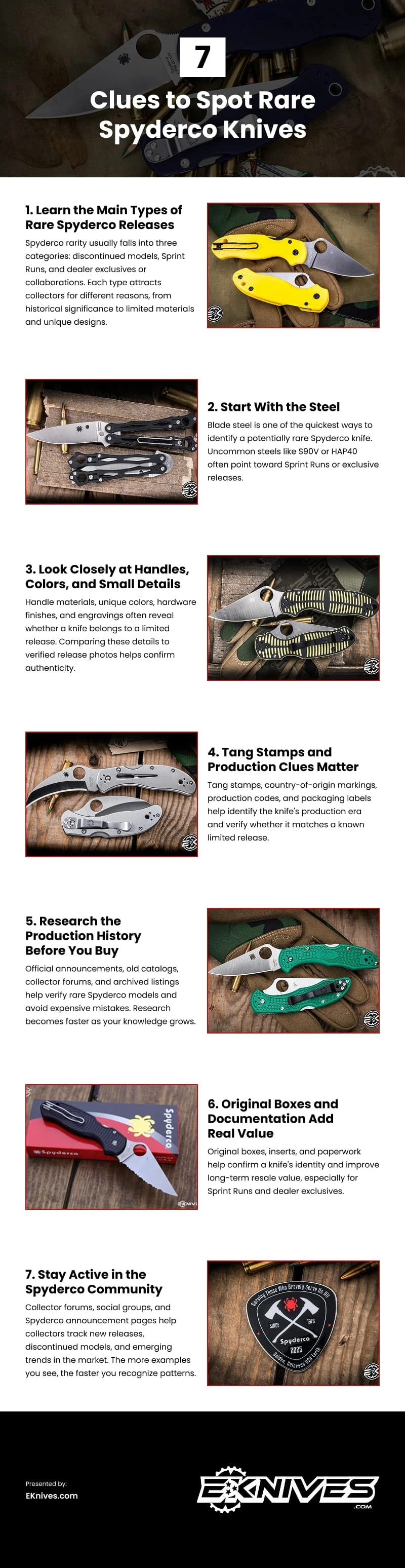
Infographic
Understanding the details that distinguish rare Spyderco knives from standard production models makes collecting far easier. This infographic highlights key identifiers that help you spot genuinely limited or rare Spyderco pieces.